History and origins of the pearl
Discover the story of Cleopatra
The pearl's journey through time
For thousands of years, the pearl has fascinated mankind. It is not only a beautiful jewel, born from the heart of oysters, but a powerful symbol of beauty, mystery, and power. The pearl is a natural treasure that humans have learned to craft with care. It spans centuries and civilizations, telling a universal story. From its prehistoric origins to its role in great ancient cultures, the pearl occupies an important place in our history and our imagination.
Upper Paleolithic (~31,000 – 12,000 BC)

More than 30,000 years ago, in caves like the Renne Cave in France, early humans were already making necklaces by stringing animal teeth and pierced shells together. These ancient beads bear witness to an early desire to create meaningful objects. Each people used whatever materials were available: bone, stone, shells, sometimes carved into animal shapes.
These jewels were not only used for decoration: they protected, told stories, and accompanied the dead. The pearl thus appears as an important symbol.
Neolithic (6000 – 3000 BC)
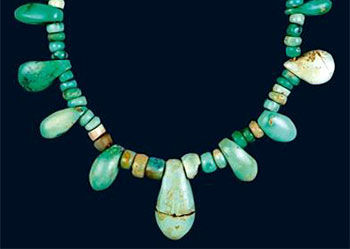
With the emergence of the first villages, humans learned to transform nature into precious objects. They collected small, smooth stones from rivers, polished by water and time, such as quartz, carnelian, and serpentine.
These stones are shaped, drilled, and assembled to create authentic, handcrafted pearls. These jewels go beyond mere decorative function: they become symbols of beauty, protection, and social belonging. Their brilliance catches the eye, their colors inspire wonder, and they are attributed powers linked to natural elements such as water, fire, and the sun.
Antiquity (3000 BC – 5th century AD)

In the great ancient civilizations of Mesopotamia, Egypt, Greece, and India, the natural pearl, extracted from oysters, aroused fascination and admiration. It was considered a divine gift, a treasure steeped in mystery.
According to myths, it was born from the tears of the gods or from the foam of the sea. Pearls adorn temples, tombs, and sacred statues, and appear in ancient texts such as the Vedas, the Bible, and Greek and Roman narratives. During this period, the pearl acquired a major symbolic role, embodying purity and eternity, and became a sacred object at the heart of religious rites and power.
The Pearl Age (1st century BC – 5th century AD)

During the Roman Empire, the pearl experienced a remarkable boom and became a clear sign of wealth and authority. Queen Cleopatra is said to have dissolved a precious pearl in vinegar and drunk it at a banquet, thus displaying her wealth and power.
From the 1st century BC onward, pearl jewelry embellished hairstyles, clothing, and temples. Their use was sometimes strictly reserved for the elite, as illustrated by the law of Julius Caesar. Pearls went beyond a simple ornamental role to become a true instrument of social communication, a symbol of luxury, status, and sometimes even excess.
Pearl making techniques over time
Since prehistoric times, humans have sought to transform natural elements into precious objects. In the Paleolithic period, they drilled animal teeth or shells to make necklaces. With the Neolithic period, techniques became more refined: stones were cut, polished, and drilled with greater precision, demonstrating growing artisanal expertise.
In ancient times, artisans mastered the art of cultivating natural pearls in oysters, developing methods to carefully harvest these treasures. These skills have evolved over the centuries, giving rise to a wide variety of jewelry, ranging from simple stone beads to intricate necklaces adorned with fine pearls.
Myths and legends surrounding the pearl
Pearls have always fascinated people, inspiring numerous stories and beliefs. In many cultures, they are seen as gifts from the gods or spirits. In Mesopotamia and Egypt, pearls are said to come from divine tears or magical sea foam.
In India, they symbolize purity and wisdom. These stories reinforce the sacred nature of the pearl, attributing protective and mystical powers to it. Even today, the pearl remains a symbol of beauty and mystery in the collective imagination.
Pearls in Art and Religion
Since ancient times, pearls have adorned sacred objects, temples, and the clothing of priests and rulers. They are present in divine statues and ritual jewelry, symbolizing purity, divinity, and eternity. In the Bible, the pearl is mentioned as a precious treasure.
In Asia, pearls play an important role in ceremonies and offerings. Their brilliance evokes divine light, strengthening the connection between the human world and the sacred. Thus, the pearl is much more than a simple ornament: it is a powerful spiritual and cultural medium.
The Pearl and Women: Beauty, Power and Identity
Since ancient times, pearls have been closely linked to the feminine figure. In many cultures, they accompany women through important life events: birth, marriage, and inheritance. They are sometimes given as dowries, worn as protective jewelry, or passed down from generation to generation. In royal courts, pearls have become a symbol of power and distinction.
Cleopatra made it a symbol of her authority. Later, Roman empresses and queens of Europe adorned themselves with it to assert their rank. But the pearl was not reserved for the elite. It also reflected the tastes, traditions, and intimate history of women in ancient societies. Sometimes, its wearing was strictly regulated: in Rome, Julius Caesar reserved pearls for wealthy women to mark their status. Throughout the centuries, the pearl has expressed beauty, strength, and women's place in the world. It embodies a discreet yet powerful language.


Comments