Important characters

The Pearl Museum invites you to discover three iconic historical figures whose stories illustrate the symbolic, economic, and cultural richness of pearls across time and continents: the Empress of China, King Malabar, and Queen Elizabeth I of England. Their journey also reveals the major developments in pearl fishing and farming techniques, as well as the impact of this precious resource on societies.
Discover the Empress of China
Antiquity and Imperial China: The Empress and the Power of Pearls
Since ancient times, China has established itself as a major center of pearl fishing and cultivation. Pearls were much more than mere ornaments: they embodied wealth, beauty, and imperial authority. The empress, a figure of prestige, was often depicted adorned with pearls, which adorned her clothing, hairstyles, and jewelry, testifying to her rank and power.
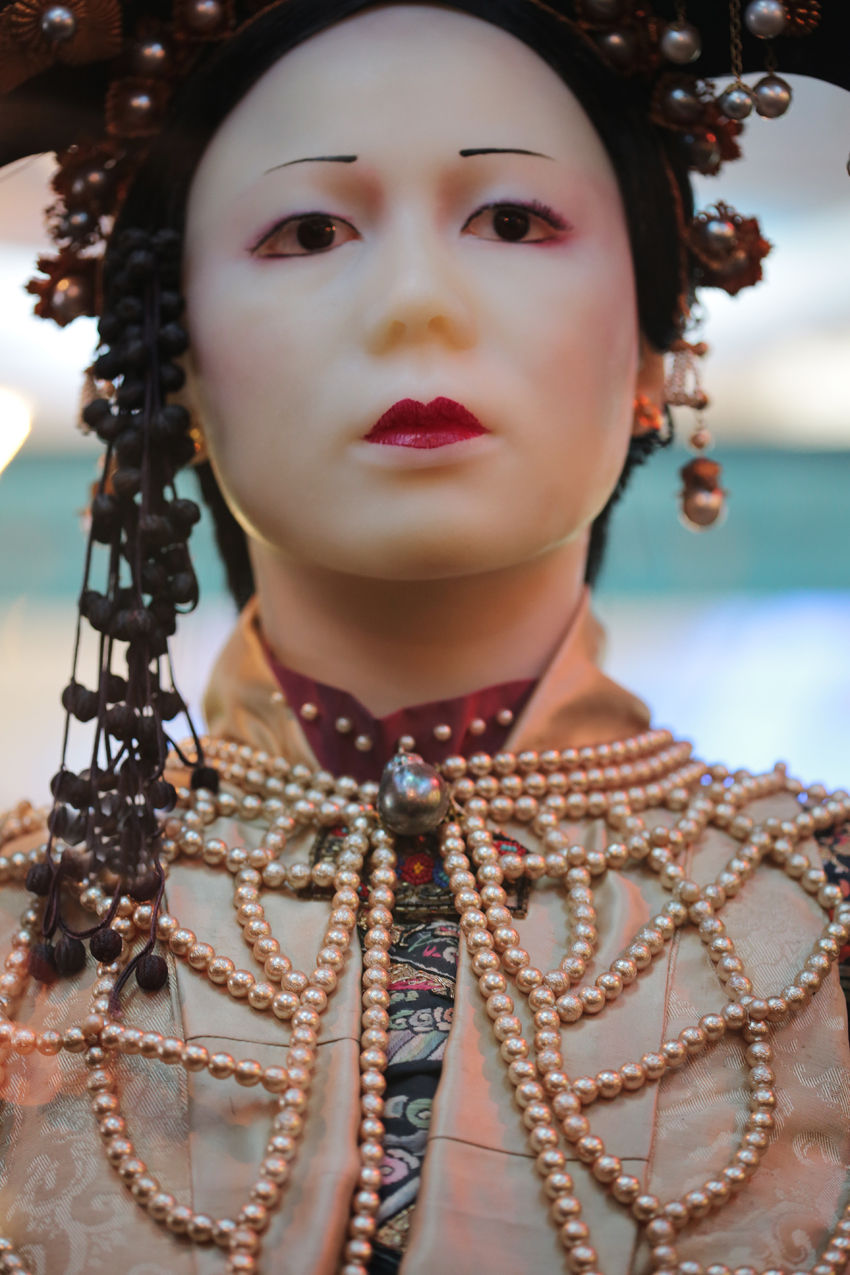
The Chinese developed advanced techniques, such as inserting small figurines into oysters to produce semi-spherical mabe pearls for jewelry and amulets. This practice demonstrates remarkable skill in manipulating nature to create treasures.
In the 19th century, this ancestral tradition inspired Mikimoto of Japan, who revolutionized pearl farming by developing the cultivation of round pearls. With the help of ama divers, expert free divers, he transformed this practice into an international industry. Mikimoto is now considered the father of the modern cultured pearl, a legacy of which China remains the world's leading producer today.
Discover the story of King Malabar
The Middle Ages and South India: King Malabar and the Pearly Splendor
Around 1290, the explorer Marco Polo stopped in the Malabar Kingdom on the southwest coast of India. There, he described an extraordinary king, literally covered in pearls: a necklace of 104 white pearls, ankle bracelets, and even toe rings. Dazzled by this brilliance, he humorously nicknamed him the "Pearl Pig," an expression that emphasizes the visible and ostentatious wealth of this ruler.

This exceptional set of jewelry is a testament to the importance of the pearl fisheries in the Gulf of Mannar, a fishing area exploited since ancient times between India and Ceylon (now Sri Lanka). For centuries, this area attracted traders, divers, and colonial powers, including the Arabs, Persians, Portuguese, Dutch, and British, in search of this precious resource.
During the harvest season, which took place every April and May, vast temporary camps were set up on the beaches, bringing together several thousand people: divers who went underwater for up to 45 seconds, traders, artisans, and even entire families. Some divers carried talismans or lucky charms intended to protect them from sharks and the dangers of the sea.
In the 20th century, this traditional fishing industry declined sharply, a victim of overfishing and the scarcity of pearl oysters, leading to the near disappearance of these activities. However, this story remains a living testament to the rich heritage and culture of southern India.
Discover the English Renaissance
The English Renaissance: Queen Elizabeth I and the Pearl Emblem
In the 16th century, Queen Elizabeth I of England, known as the "Virgin Queen," used pearls as a powerful political symbol. In an era marked by religious and political tensions, pearls embodied chastity, purity, and sovereignty. Her official portraits show her adorned with sumptuous necklaces, bracelets, and earrings, sometimes in impressive quantities.

Among her most famous pieces are the "Medici pearls," a necklace made up of over 600 white pearls. These pearls have a rich history, having belonged to Catherine de Medici, then to Mary Stuart, Elizabeth's cousin and rival, before coming into the hands of the Queen of England after Mary Stuart's execution.
Elizabeth I also believed in the medicinal properties of pearls, especially black pearls, which were used for their supposed healing and protective properties. Thus, pearls served a dual role: as a prestigious adornment and a valuable remedy.
This passion for pearls illustrates the importance of mother-of-pearl gems in the construction of the royal image, but also in the economic and diplomatic exchanges of the Renaissance.


Comments